
While I was planning a trip to Barcelona with my oldest son, the area I was most looking forward to seeing was the Barri Gothic (Gothic Quarter), which is the historic center of the city. I imagined walking along the cobblestone streets and admiring the historic architecture while thinking about the generations of people who lived there in the past. I was especially excited to visit the Jewish quarter to see what that looked like.
It turns out that my expectations were overly high. The area of the Gothic Quarter we entered was packed with tourists and souvenir shops. After walking through the crowded areas, we did arrive at quieter parts of the neighborhood, but I didn’t expect to see so much graffiti, especially on the door of what was at one time a synagogue in the Jewish Quarter (also known as El Call). The synagogue is open for tours, but unfortunately not at the time that we were in the city so we weren’t able to go inside.
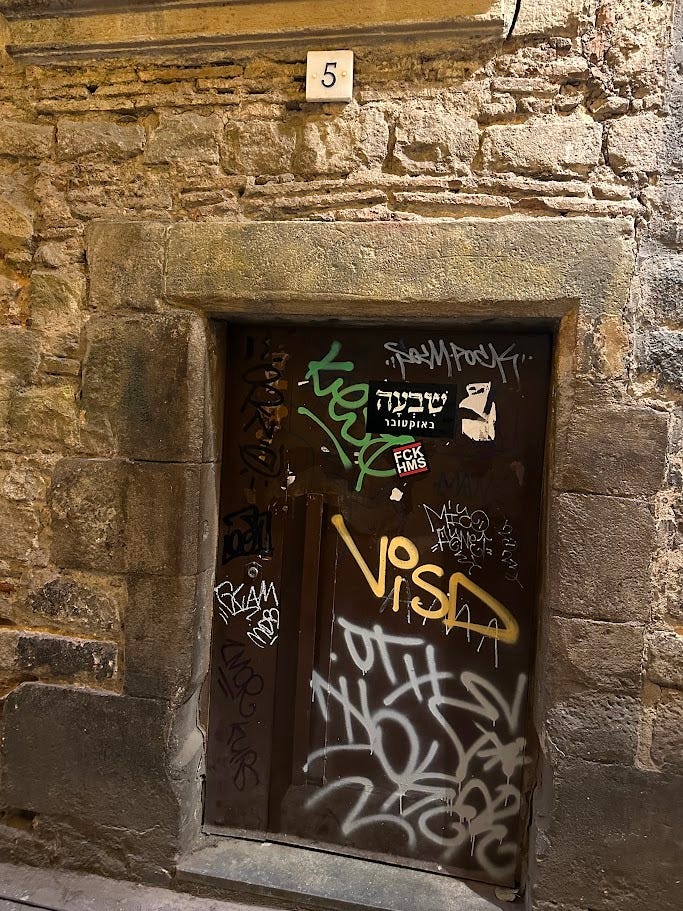
I guess I was envisioning more of a Disneyland or Universal Studios version of a historic Barcelona neighborhood instead. In retrospect, I understand that it was unrealistic because a historic city has no obligation to keep it nice for tourists, but it saddened me that its residents didn’t seem to appreciate how cool it is to have these historic buildings.
To provide some perspective, I live in Phoenix, where the oldest known structure that still exists is from the late 1800s.
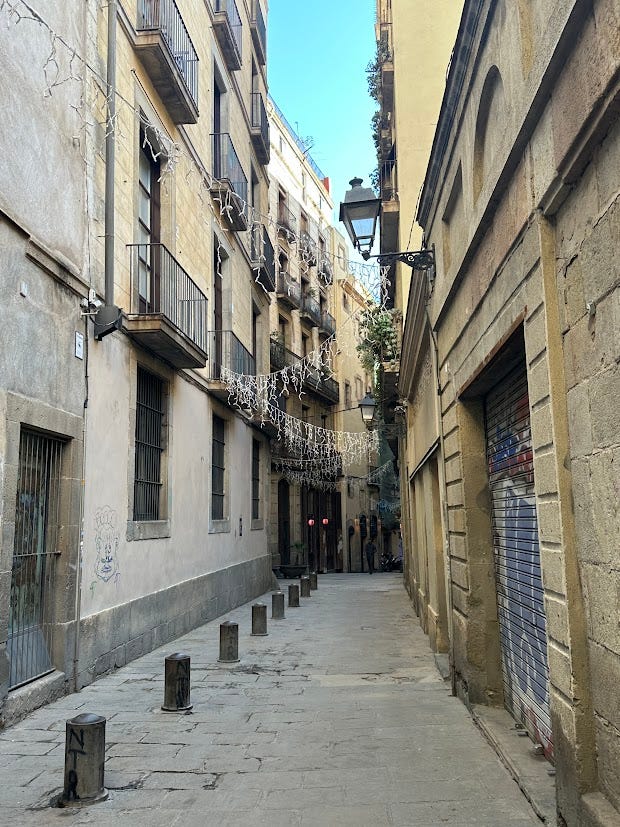
I don’t know what I was expecting to feel while walking among those streets, but one thing on my mind was the Jewish residents who lived there hundreds of years ago. I envisioned them walking to the synagogue on those narrow pathways on Shabbat and felt the sorrow of their eventual tragic fate. Approximately 300 Jews were killed in Barcelona during the 1391 pogroms in Spain. (Thousands were killed throughout Spain over a few months.) Others were forced to convert to Catholicism in order to survive. According to historians, that was considered the turning point of the end of the Golden Age of Spanish Jewry as it was followed by a century of violence and persecution that culminated in Jews being expelled from Spain in 1492.
I wondered whether members of the Jewish community had any inclination about the hatred and antisemitism that led to the massacres. I was disgusted not only by the vandalism, but also that somebody hung a Palestinian flag high up on the front of the building above the synagogue door. Where does all this hatred come from? Nobody can blame the 1391 massacres on Israel or Zionism. In fact, massacres like the one in 1391 and the 1492 expulsion, as well as pogroms against Jews in other areas of Europe, are what led to the development of Zionism – the belief that Jews should return to their ancestral homeland and have an independent state where they can live in freedom and safety.
I recently read the book “One Hundred Saturdays: Stella Levi and the Search for a Lost World,” which is the result of six years of conversations between author Michael Frank and Stella Levi, a Holocaust survivor from the island of Rhodes, which is now part of Greece.
The Jewish community in Rhodes dates back to at least the 12th century and in 1522, the island became part of the Ottoman Empire for about four centuries. In 1912, Italy seized Rhodes from the Ottomans during the Italo-Turkish War and Italy occupied the island until it was invaded by Germany in September 1943.
Stella Levi was born on the island in 1923 and grew up speaking French, Italian, Turkish and Greek, in addition to Ladino (Judaeo-Spanish, a language spoken by Sephardic Jews). In a 2022 article in The Times of Israel, Stella called Rhodes, “a very special place where different groups of people with different backgrounds and religions managed to live together, more or less in peace, for centuries.”
In 1939, Stella and her fellow Jewish classmates were banned from attending school, a result of Italy’s fascist government enacting anti-Jewish laws. In July 1944, the entire Jewish community of Rhodes, approximately 1,700 people, was deported to Auschwitz, a Nazi concentration camp in Poland.
Her parents, aunts and cousins all were killed – only she and her sister, Renee survived Auschwitz and they eventually moved to the U.S. where their older siblings had moved before the war. Stella didn’t end up returning to Rhodes until the 1970s because it was too painful.
Today the Juderia – the Jewish quarter of the island – is filled with cafes and tourist shops, according to a recent article, but before WWII it was filled with the daily life of the Rhodeslis, who were descendants of the Jews who arrived after the Spanish Expulsion in the late 15th century.
Visiting the Jewish quarter in Barcelona was another reminder of a Jewish community that was decimated because of antisemitism and hatred. Some people may think that today’s Jewish community at large is overreacting to the increase in antisemitic acts around the world in the past few years, but having college students call for the destruction of the one Jewish state as they harass Jewish students and a band condemn the one Jewish state in bright lights onstage at one of the largest music festivals in the world is a warning sign that perhaps the hatred that led to the Holocaust still exists.
There are many countries that used to have large Jewish communities. Iraq, Egypt, Algeria and Morocco, all had large Jewish communities at one time. At certain times in history, Jewish communities thrived in areas, while in other times they struggled or completely disappeared from those same areas. Many people typically view the world through a tiny lens of what exists today and don’t factor in what’s happened in the past and overlook the possibility of how quickly things can change.
In social media posts, people interviewed at anti-Israel rallies carrying “Free Palestine” signs (or even just a random person working at a coffee shop wearing a “Free Palestine” T-shirt) will defend advocating that phrase, saying that they are against genocide. But when you ask them about Oct. 7 or the hostages who are still being held in Gaza, they get a blank, confused look on their face, seemingly completely ignorant that they are supporting people who broke into another country and murdered, raped and kidnapped civilians from their homes and at a music festival.
Throughout my life, whenever I heard different accounts from Holocaust survivors about what they experienced during that horrific time in history, I never imagined that in 2025 Jewish communities around the world would still be dealing with the same hatred and antisemitism. But one lesson I was reminded of in Barcelona is that there’s no guarantee that the world we know today will exist in the future.
This article originally appeared on the “A Medley of Moments” Substack.
 Leisah Woldoff